How a rocket engine works, and why ISRO's cryogenic engine is special
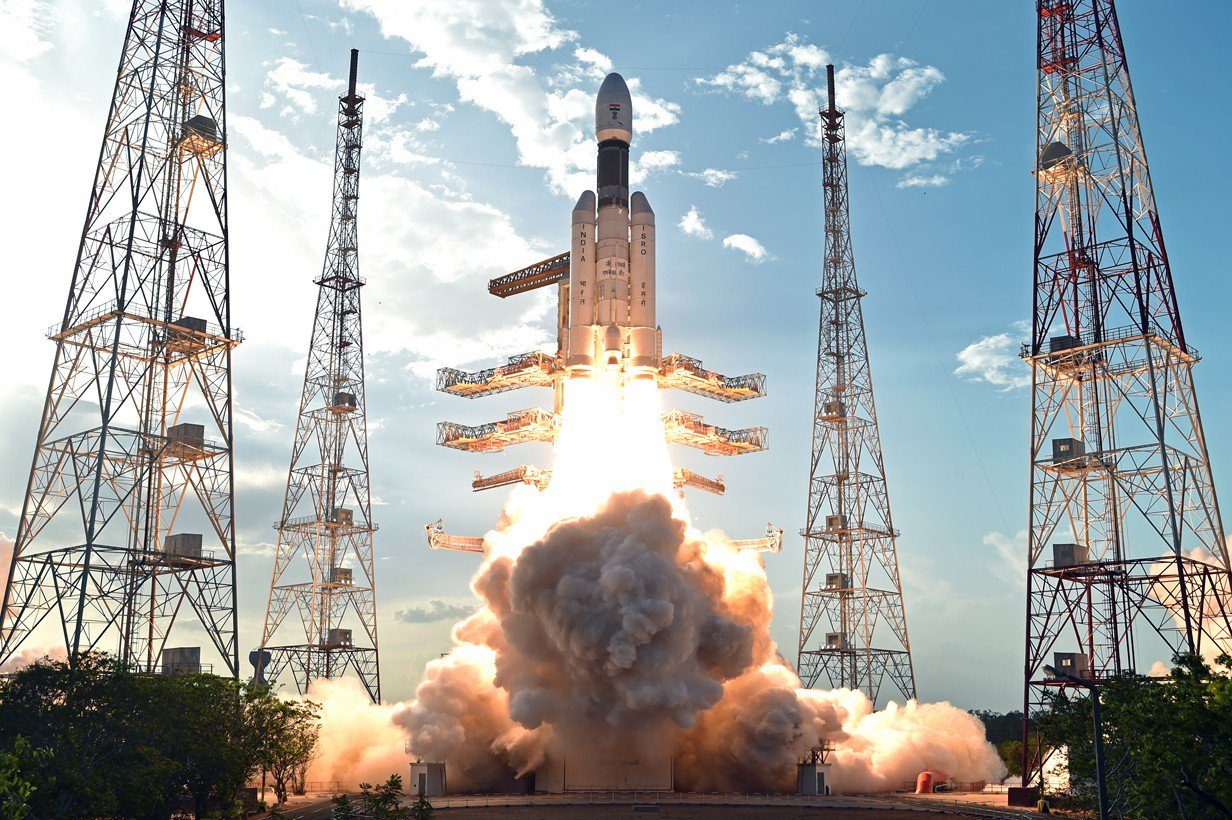
On 5 November, deep in the hills of Tamil Nadu's Mahendragiri, an engine roared for 200 seconds without going anywhere. It was tied down to a test stand, burning fuel colder than anything in your fridge. That test clears the engine to be fitted into the GSLV rocket that will carry India's navigation satellite NVS-04 into space.
To understand why this matters, let's start with something you have probably done at a birthday party.
A rocket is a very serious balloon
Blow up a balloon, pinch the neck, then let go. It zips around the room. Why? The air rushing out of the back pushes the balloon forward.
This is Newton's third law of motion: when one thing pushes on another, the second thing pushes back just as hard, in the opposite direction. A rocket works exactly like this. It burns fuel to make hot gas, and shoots that gas out of the back at enormous speed. The gas is pushed backwards, so the rocket is pushed forwards.
Here's the clever bit: a rocket doesn't need air to push against. That is why it works in space, where there is no air at all. But fire needs oxygen, so a rocket must carry its own oxygen along with its fuel, like packing both the stove and the gas cylinder for a long trip.
What 'cryogenic' means
'Cryogenic' means extremely cold. A cryogenic engine burns liquid hydrogen as its fuel and liquid oxygen to help it burn. Both are normally gases. To turn them into liquids, you have to chill them to temperatures that are hard to imagine.
Liquid oxygen has to be kept below minus 183 degrees Celsius. Liquid hydrogen is even colder, below minus 253 degrees. Your home freezer is nowhere near that cold, not even close.
Why go to all this trouble? Because hydrogen and oxygen make one of the most efficient pairs of rocket propellants we know. For the same amount of fuel, they give a much bigger push than the fuels used in ordinary rocket stages. Think of it as the difference between an auto-rickshaw that gives you great mileage and one that guzzles fuel. On a trip to space, every kilogram saved means more satellite you can carry.
Turning gases into liquids helps too. Liquids take up far less space, so the tanks can be smaller and lighter.
Why it's so hard
Handling something that cold is tricky. Liquid hydrogen is also very light: a litre of it weighs only about 70 grams, while a litre of water weighs a kilogram. So it needs huge tanks, and those tanks must be wrapped so well that the fuel does not boil away.
Then the fuel has to be pushed into the engine extremely fast. Cryogenic engines use spinning pumps called turbopumps, and some spin tens of thousands of times a minute. Meanwhile, that super-cold fuel is feeding a roaring fire inside the same machine. Getting all of this to work together, perfectly, every time, is the real challenge.
Only six countries have flown working cryogenic engines: the United States, Russia, France, China, Japan and India.
India's long road to its own engine
India's journey here was not smooth. In 1991, India signed a deal with a Russian company to get cryogenic engines along with the know-how to build them. But in 1992, after objections from the United States, Russia pulled out of sharing the technology. Russia still sold India seven ready-made cryogenic stages, but not the secret of how to make them.
So in 1994, ISRO started building its own. It was like being handed a few ready meals instead of the recipe, and deciding to learn to cook yourself. The first flight of India's home-made engine, in April 2010, failed: the engine lit up, but shut down within half a second because one pump ran short of fuel.
ISRO kept at it. On 5 January 2014, the indigenous CE-7.5 engine finally flew successfully on the GSLV-D5 rocket. In June 2017, a bigger engine called the CE-20 made its first flight on the LVM3, the rocket that later carried Chandrayaan-3. The CE-20 has also been made safe enough for Gaganyaan, India's mission to send astronauts into space.
What happened this November
Before any engine goes on a real rocket, ISRO fires it on the ground in what is called a flight acceptance test. Think of it as a final net session before a big match. On 5 November, the cryogenic engine picked for the GSLV-F19 mission ran for 200 seconds at the ISRO Propulsion Complex in Mahendragiri. Both its main engine and a smaller part that drives its pumps lit up as planned, and the engine performed just as predicted, ISRO said.
The engine will now be fitted into the rocket's cryogenic stage. GSLV-F19 is set to launch NVS-04, one more satellite for NavIC, India's own navigation system.
So what?
NavIC is India's own version of GPS. Satellites like NVS-04 help people and vehicles work out exactly where they are, without depending only on another country's system. And the cryogenic engine is the part that gives the rocket that final, heavy-lifting push into high orbit.
The bigger lesson is about patience. A technology India was once denied is now made at home, tested in Tamil Nadu, and trusted for human spaceflight.
- 5 Nov 2026 flight acceptance test, 200 s, IPRC Mahendragiri, GSLV-F19/NVS-04: ISRO
- CE-20 first flight (2017), Chandrayaan-3 and Gaganyaan role: Wikipedia
- Newton's third law and engine thrust: NASA Glenn Research Center
- Propellant temperatures and densities; countries with cryogenic engines: Wikipedia
- 1991 deal, 1992 withdrawal, 7 KVD-1 stages, 1994 project start: Wikipedia
- CE-7.5: 1994 project, 2010 failure, 2014 success, size, burn time: Wikipedia
Spotted a mistake or have an idea for a read? Write to [email protected].
